First, separate words that look alike
In articles and conversations about AI, terms such as:
- AI
- Machine Learning
- Model
- Language Model
- LLM
- AI service
are sometimes used as if they referred to the same thing. But they are not synonyms. This book starts by sorting out these differences.
AI does not mean only LLM
AI (Artificial Intelligence) is not a word that refers only to LLMs. Machine Learning is a field related to AI, but it too is not synonymous with AI as a whole.
There's no need to classify all of AI completely here. It's enough to understand that AI = LLM does not hold. The generative AI and LLMs commonly seen today are important subjects when thinking about AI, but they don't represent the whole of AI by themselves.
Model, Language Model, LLM
A Model is something we treat as distinct from the AI service itself. A Language Model can be explained as a type of model that handles language. LLM is short for Large Language Model. In other words, we can think of the relationship this way:
Model
  └─ Language Model
       └─ LLM
Model and AI service are not the same
The AI service a user uses and the model used internally are not the same thing either. An AI service can combine software functions other than the model. For example, depending on the service, things such as:
- Search
- Retrieval
- external tools
may be used. Because of this, you cannot simply decide that the behavior of an entire service is "a property of the model itself."
Whichever of these — model-based generation, service-side functionality, access to external information, or an external tool — actually accounts for a given response, and to what extent, may not be determinable without public information or observable evidence. The details are covered later.
How to read Software, Service, and System
From here on, this book also uses the words software, service, and system. For beginners, keep the following distinction in mind first:
Model
≠
the entire service a user interacts with
When considering a service as a whole, multiple elements are relevant — not just the model, but also the software functions and external features that use it. When this book uses the word system, it is not automatically treated as meaning "just one model" either.
How much you actually know about the model, versus what is really a statement about the service or system as a whole
— that's the distinction this is meant to avoid confusing.
Transformer is also a separate subject
The word Transformer also comes up frequently. Transformer, LLM, and AI service are terms referring to distinct things, and are not treated as synonyms. What role a Transformer plays is covered in Chapter 4, when we look at how a model generates output from input.
Putting it in a diagram
Simplifying the relationships covered so far gives us the following:
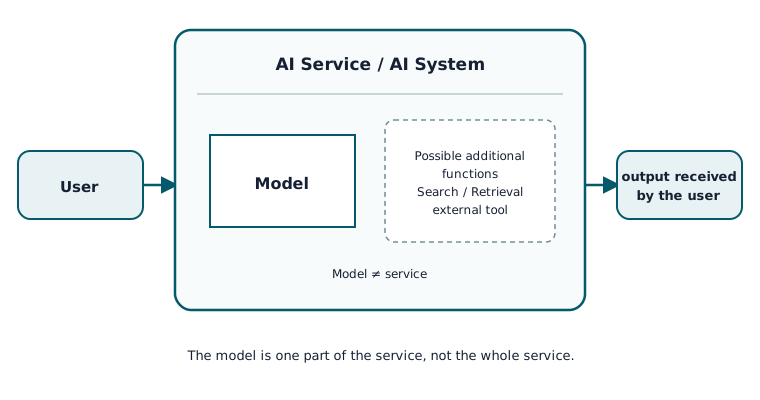
This diagram exists to avoid treating "the model" and "the entire service the user interacts with" as the same thing.
Chapter summary
The most important thing in this chapter is the following set of distinctions:
AI != LLM
Model != AI service
LLM != AI service
Transformer != LLM
You don't need to memorize a complete classification of AI. Keep in mind that:
- AI does not mean only LLM
- Machine Learning and AI as a whole are not the same
- a Language Model can be explained as a type of model
- LLM refers to Large Language Model
- a model and an AI service are not the same thing
- a service may involve functions other than the model
- the behavior of a service as a whole should not automatically be assumed to be a property of the model itself
The next chapter looks at how these terms arrived at their current form, as a short map of history.